Roman period, late 1st c.
Ancient Theatre
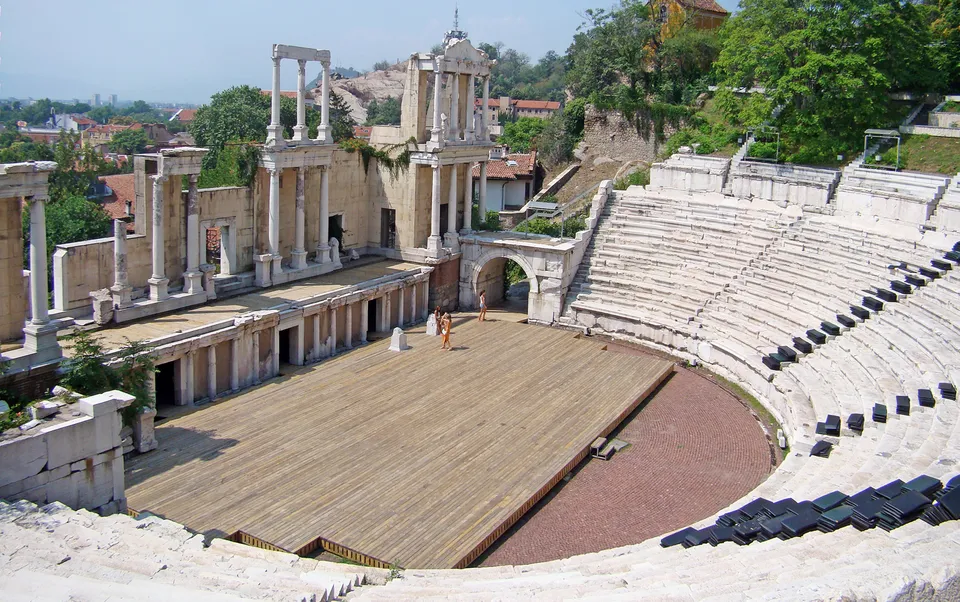
Probably the best-known ancient monument in Bulgaria, built in the 90s of the 1st century AD under Emperor Domitian. Set in the saddle between two of the three hills, it seated about 7,000 on two tiers of 14 rows each. Studied and restored between 1968 and 1984, it is among the best-preserved Roman theatres in the world and still hosts the Opera Open and other festivals.
Story of the place
How to read this place
The Ancient Theatre of Philippopolis is one of the best-preserved Roman theatres in the world. Set in the saddle between the Dzhambaz and Taksim hills, it was built almost two millennia ago and today again gathers audiences under the open sky.
- Built
- 1st c. AD
- Seats (ancient)
- 5,000–7,000
- Seats (today)
- ≈ 3,500
Seat of the province
The theatre was built in the 1st century AD, probably under Emperor Domitian. Besides performances it served as the seat of the Thracian provincial assembly — honorary inscriptions for city councillors, magistrates and imperial associates survive on its marble seats.
Source trail: Wikipedia — Roman theatre of Philippopolis ↗How it was built
The outer diameter is 82 metres, and the seating — 28 concentric rows of marble — held between 5,000 and 7,000 people. The names of the city quarters were carved into the benches so citizens knew where to sit. The stage building (scaenae frons) rose three storeys, with Ionic and Corinthian marble colonnades and three symmetrical gates.
Source trail: Wikipedia — Roman theatre of Philippopolis ↗Ruin and rediscovery
At the end of the 4th century much of the theatre was destroyed, probably by fire or earthquake, and gradually buried. It was only rediscovered in the early 1970s after a landslide, when about 4.5 m of earth was removed. Its restoration by anastylosis is regarded as one of the greatest achievements of the Bulgarian conservation school.
Source trail: Wikipedia — Roman theatre of Philippopolis ↗A stage to this day
Facing south toward the former lower town and the Rhodope Mountains, the theatre is once more a working stage, seating about 3,500 spectators for opera, concerts and festivals through the warm months.
Source trail: Wikipedia — Roman theatre of Philippopolis ↗Dating
Roman period, late 1st c.
Source trail: Wikipedia — Plovdiv ↗Architect/builder
not identified in the current public source
Source trail: Wikipedia — Plovdiv ↗Current status
Publicly documented historic site; detailed visiting status still needs verification.
Open map ↗Public Wikidata record
Roman theatre in Plovdiv, Bulgaria
- Type
- Roman theatre
- Address
- ул. "Цар Ивайло" № 2А, град Пловдив
Traces and evidence
-
Description and historical context for Ancient Theatre.
Source trail: Wikipedia — Plovdiv ↗ -
Coordinates for Ancient Theatre.
Source trail: Coordinates (Wikidata) · Ancient Theatre ↗ -
Media and license for Ancient Theatre: Antique-theater-plovdiv.jpg.
Source trail: Wikimedia Commons — Antique-theater-plovdiv.jpg ↗
Current status
Publicly documented historic site; detailed visiting status still needs verification.
Ownership, care and institutions
The institutional context runs through Plovdiv Municipality, Plovdiv Municipal Council and Plovdiv 2019 Foundation. That is not automatically an ownership history; it is a verifiable trail of public care, memory or governance.
- Plovdiv Municipality
- Plovdiv Municipal Council
- Plovdiv 2019 Foundation
Connected people
No people are linked in the current knowledge base.
Visit and orientation
- Coordinates
- 42.14684, 24.75101 · wikidata_coordinate
- Built/date
- Roman period, late 1st c.
- Architect/builder
- not identified in the current public source
Full event stream
All 3 linked events are grouped by record type.
historical_timeline 2 records
-
The Roman theatre is built
A deciphered inscription dates the construction of the Ancient Theatre to the 90s of the 1st century AD. The municipality’s archaeological overview gives it about 6,000 seats; the site remains an active contemporary cultural venue.
-
The Roman Odeon
The small antique theatre — the Odeon — was first built as a bouleuterion (the city-council house) with about 350 seats, and later rebuilt as a theatre. It is the second antique theatre of Philippopolis.
cultural_programme 1 records
-
Scale of the European Month of Culture
The Pod tepeto archive article describes Plovdiv as the first Bulgarian city to host the EU's major cultural programme. The programme opened on 28 May and ran until 1 August 1999; it cites about 5,000 artists, including 3,000 Bulgarian artists and 2,000 from 45 countries, about 250 events, including 80 music events, 45 theatre events and 45 exhibitions/art actions. It also notes repairs to the Drama Theatre, City House of Culture and Ancient Theatre.
Around this place
Connected places show that this site works as part of a wider urban system: Plovdiv and The Seven Hills (tepeta).
Then/now
 Then Reference photo
 Uncovering the Ancient Theatre - image 1 — then/now
Comparison between the archive image “Uncovering the Ancient Theatre - image 1” and a modern open-licensed image of Ancient Theatre.
Editorial review: This pairing of a historical image and a reference photo was automatically prepared and is shown as a provisional reference; independent editorial review of the visual match, licence and attribution information, and context is still pending.
- Match
- same place, approximate viewpoint
- Then
- Credit: Realsteel007 Media file CC BY 4.0 accessed 2026-06-19
- Reference photo
- Credit: CivArmy Media file CC BY 4.0 accessed 2026-07-09
Archive for this place

excavation period, 20th c.
Uncovering the Ancient Theatre - image 1
Photographic archive material from the uncovering of the Ancient Theatre.
Editorial review: This archive record was automatically prepared from Wikimedia Commons and is shown as a provisional reference; independent editorial review and more precise georeferencing are still pending.
Source: Wikimedia Commons — Razkrivane antichen teatur.jpg ↗
excavation period, 20th c.
Uncovering the Ancient Theatre - image 2
Second archive image from the uncovering of the Ancient Theatre.
Editorial review: This archive record was automatically prepared from Wikimedia Commons and is shown as a provisional reference; independent editorial review and more precise georeferencing are still pending.
Source: Wikimedia Commons — Razkrivane antichen teatur1.jpg ↗