National Revival, 19th c.
The Old Town (Old Plovdiv)
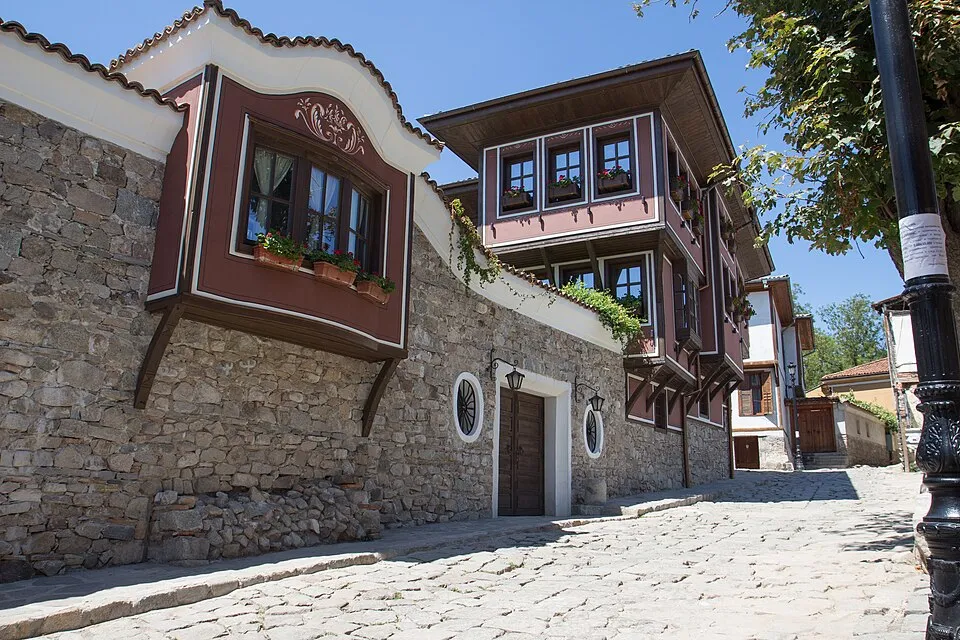
An architectural-historical reserve on Nebet, Dzhambaz and Taksim Tepe, famous for its 19th-c. Revival houses — such as the Kuyumdzhioglu House (1847, now the Ethnographic Museum). It has been on UNESCO's tentative list since 2004.
Story of the place
How to read this place
The Old Town of Plovdiv climbs across three of the city's hills, where six thousand years of habitation lie layered one upon another — Thracian, Roman, medieval and, most visibly, the painted timber mansions of the Bulgarian National Revival.
- Reserve
- ≈ 35 hectares
- UNESCO (tentative)
- since 2004
- Habitation
- ≈ 6,000 years
Six thousand years on three hills
The reserve spreads across the hills of Nebet Tepe, Dzhambaz Tepe and Taksim Tepe. Settlement began remarkably early — around 4000 BC. After the Thracians came expansion under Philip II of Macedon about 342 BC, and from 46 AD Roman rule, so the site has been continuously inhabited for more than six thousand years.
Source trail: Wikipedia — Old Town (Plovdiv) ↗The Revival town
In the 19th century wealthy merchants turned Plovdiv into an important economic centre. The Revival houses of 1800–1900 have symmetric facades with oriels, carved-wood ceilings and rich floral and geometric murals, while inner courtyards hide gardens and fountains. Their many storeys step down the slope of the hill.
Source trail: Wikipedia — Old Town (Plovdiv) ↗A living museum
The architectural-historical reserve covers about 35 hectares and has been on UNESCO's World Heritage tentative list since 2004. It combines the culture of Antiquity, the Middle Ages and the Revival, and its houses and churches today hold museums and cultural venues.
Source trail: Wikipedia — Old Town (Plovdiv) ↗What to see
Among the best-known houses are the Kuyumdzhioglu House (1847), today the Regional Ethnographic Museum, spread over 570 m² with 130 windows; the richly decorated Hindliyan House (1835); and the Balabanov House. Close by stand the medieval Hisar Kapia gate and the Ancient Theatre.
Source trail: Wikipedia — Old Town (Plovdiv) ↗Dating
National Revival, 19th c.
Source trail: Wikipedia — Old Town (Plovdiv) ↗Architect/builder
not identified in the current public source
Source trail: Wikipedia — Old Town (Plovdiv) ↗Current status
Publicly documented historic site; detailed visiting status still needs verification.
Open map ↗Public Wikidata record
old part of Plovdiv, Bulgaria
- Type
- quarter
- Status/protection
- Tentative World Heritage Site
Traces and evidence
-
Description and historical context for The Old Town (Old Plovdiv).
Source trail: Wikipedia — Old Town (Plovdiv) ↗ -
Coordinates for The Old Town (Old Plovdiv).
Source trail: Coordinates (Wikidata) · The Old Town (Old Plovdiv) ↗ -
Media and license for The Old Town (Old Plovdiv): Renovated house in plovdiv old town.jpg.
Source trail: Wikimedia Commons — Renovated house in plovdiv old town.jpg ↗
Current status
Publicly documented historic site; detailed visiting status still needs verification.
Ownership, care and institutions
The institutional context runs through Plovdiv Municipality, Plovdiv Municipal Council, Regional History Museum — Plovdiv and International Fair Plovdiv. That is not automatically an ownership history; it is a verifiable trail of public care, memory or governance.
- Plovdiv Municipality
- Plovdiv Municipal Council
- Regional History Museum — Plovdiv
- International Fair Plovdiv
Connected people
No people are linked in the current knowledge base.
Visit and orientation
- Coordinates
- 42.14982, 24.75267 · wikidata_coordinate
- Built/date
- National Revival, 19th c.
- Architect/builder
- not identified in the current public source
Full event stream
All 7 linked events are grouped by record type.
historical_timeline 3 records
-
A leading Balkan trading centre
Through this period Filibe was one of the largest economic centres in the Balkans, alongside Istanbul, Edirne, Thessaloniki and Sofia. Wealthier citizens built fine houses, many still preserved today in the Old Plovdiv architectural reserve.
-
Saving Plovdiv's Jews
On 10 March 1943 Metropolitan Kiril of Plovdiv intervened for the local Jewish community gathered for deportation and became one of the visible figures in preventing the deportation of Jews from Bulgaria's pre-war territory.
-
World's Fair exhibitions
Plovdiv hosted specialized exhibitions of the World's Fair (Expo) in 1981, 1985 and 1991. Through the 1970s and 1980s its ancient remains were excavated and the Old Town was fully restored.
municipal_programme 3 records
-
Nursery, public kitchens and old people home under Bozhidar Zdravkov
Under mayor Bozhidar Zdravkov, Plovdiv opened the second nursery of its kind in Bulgaria and the municipality allocated over BGN 600,000 over three years. Public kitchens began, the first stage of a new old people home was completed and a shelter for beggars was created.
-
Specialised Old Plovdiv administration
On 1 April 1969, a specialised Old Plovdiv administration was created under the city people's council. The study cites an operating programme through 1975 and BGN 600,000 for 1969, while the city's annual budget was about BGN 25M.
-
Project list for the final Sofia-waste transfer
Council of Ministers Decree 307 from 30 November 2012 approved up to BGN 8,488,887 for infrastructure works implementing the 7 October 2009 decision. The annex lists works including the Maritsa South Boulevard extension, pavements, street lighting, a Maritsa river bridge with junctions, Northern Boulevard, Asenovgradsko Shose widening, design for Tsarevets Street, Komatevsko Shose, Ruski Boulevard, the central and old-town areas, the Odeon project, Blue Zone equipment, the Water Palace breakthrough, kindergartens, bicycle lanes, the south-eastern bypass and the Small Basilica.
governance_change 1 records
-
Municipal power transfer after 9 September 1944
The Regional History Museum Plovdiv study describes how, on 9 September 1944, the previous municipal leadership headed by Dimitar Kostov was replaced by a Fatherland Front administration with Dr Asen Kozhuharov as mayor. This gives context to the official mayoral chronology.
Around this place
Connected places show that this site works as part of a wider urban system: Plovdiv.
Then/now
 Then Reference photo
 Street in Philippopolis, January 1878 — then/now
Comparison between the archive image “Street in Philippopolis, January 1878” and a modern open-licensed image of The Old Town (Old Plovdiv).
Editorial review: This pairing of a historical image and a reference photo was automatically prepared and is shown as a provisional reference; independent editorial review of the visual match, licence and attribution information, and context is still pending.
- Match
- same place, approximate viewpoint
- Then
- Credit: Unknown author Media file Public domain accessed 2026-06-19
- Reference photo
- Credit: Faces&&Places Media file CC BY 2.0 accessed 2026-06-19
Archive for this place

January 1878
Street in Philippopolis, January 1878
Early photograph of a street in Philippopolis/Plovdiv, georeferenced to the Old Town as approximate urban context.
Editorial review: This archive record was automatically prepared from Wikimedia Commons and is shown as a provisional reference; independent editorial review and more precise georeferencing are still pending.
Source: Wikimedia Commons — 0530 Вид на одну из улиц Филиппополя (Пловдива), январь 1878.jpg ↗